Definition of watertight and associated surfaces
Watertight
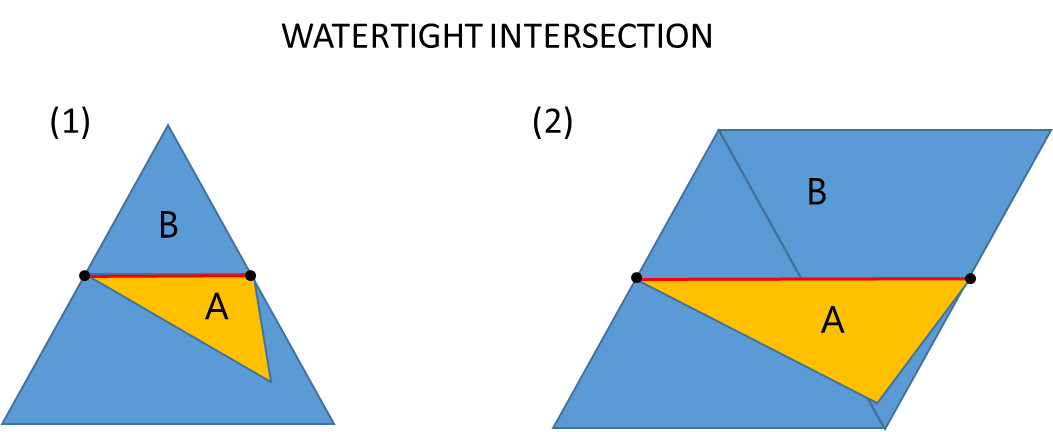
Image (1) shows a watertight intersection (in red). An intersection is watertight when the triangle edges at the edge of Surface A lie exactly on each triangle plane of Surface B.
You achieve watertight intersections between horizons and faults when you use the ‘watertight’ option during surface construction of the structural model (see Constructing surfaces). This works as follows: the triangles of the horizon surface around the intersection are wiped out. Then, at the location where the horizon surface needs to be constructed, the fault surface receives nodes on its triangle edges. Next, horizon surface triangles are generated around the intersection, based on these new nodes. As a result, the edge of the horizon surface lies exactly on the triangle planes of the fault. See image (1) below where Surface A represents the re-triangulated horizon surface, and Surface B represents the fault surface. Note that in this process the fault surface remains untouched (i.e. it is not re-triangulated).
Image (2) shows the only situation where an intersection can be watertight even though not all triangle edges of Surface B received a node (notice that a node is missing on the triangle edge in the middle). Watertightness in this case is only possible when the triangles of Surface B lie in a flat plane.
Associated surfaces
When surfaces are associated, both surfaces have nodes at the same locations along their common boundary (‘node pairs’). In essence it is more strict than ‘watertightness’ and a requirement for volume meshing.
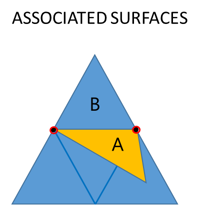
For the application to associate surfaces, their intersections should already be watertight (i.e. image (1) above). When ‘association’ takes place, nodes are added to Surface B at the same locations where Surface A nodes already existed. This is demonstrated in the image below, where red nodes are added to the locations where the black nodes already existed. Subsequently, Surface B is re-triangulated based on the new node positions (notice that Surface B below has four triangles, compared to one triangle in the watertight situation in image (1) above).